
Advancing the Australia–Korea relationship
The Australia–Korea Business Council (AKBC) is the leading independent business organisation dedicated to strengthening the Australia–Korea relationship.
For more than four decades, AKBC has worked alongside business leaders, governments and industry to advance policies that deepen trade and investment, strengthen economic security, improve market access and create new commercial opportunities between Australia and the Republic of Korea.
As the bilateral relationship continues to evolve beyond traditional resources and energy into critical minerals, defence, advanced manufacturing, artificial intelligence, clean energy, life sciences and digital technologies, AKBC plays an important role in ensuring that public policy keeps pace with business opportunity.
We work constructively with Australian and Korean governments to identify barriers to bilateral trade and investment, advocate for practical policy solutions and provide industry with a trusted, independent voice on issues affecting the Australia–Korea economic partnership.
Our advocacy is always guided by one objective: to build a stronger, more connected and more prosperous Australia–Korea relationship.
How we advocate
AKBC advocates on behalf of members through:
- Our annual Canberra Leadership Summit
- Policy submissions to Australian and Korean governments
- Direct engagement with Ministers, Parliamentarians and senior officials
- Bilateral government and industry roundtables
- Industry consultation with members and stakeholders
- Strategic policy papers and thought leadership
- Collaboration with partner organisations in Australia and Korea
- Representation of member priorities through the Australia–Korea policy dialogue
Our advocacy focuses on issues that improve the long-term competitiveness of the bilateral relationship rather than representing the interests of any single organisation.
Current advocacy priorities
Our current areas of advocacy include:
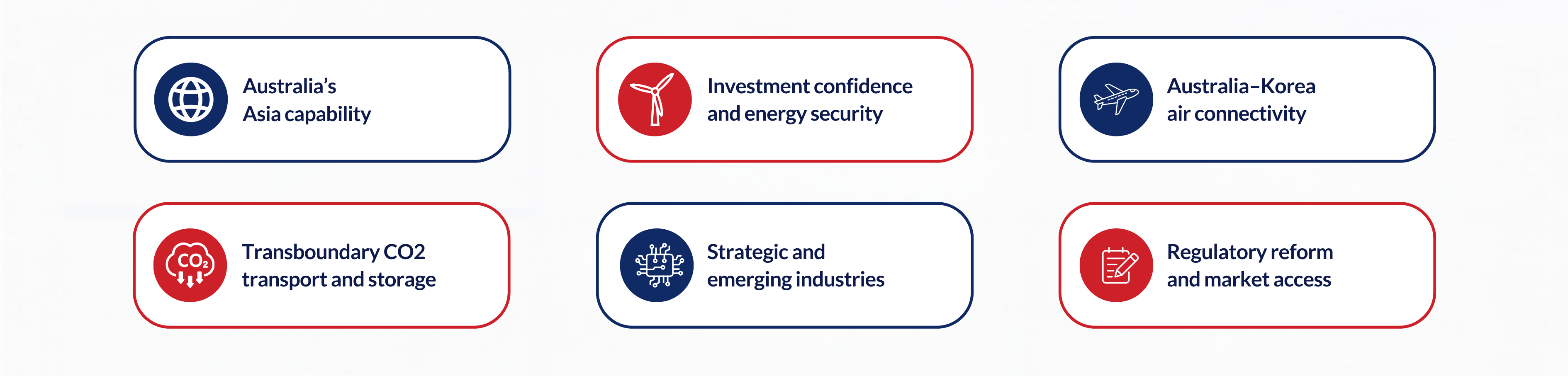
Strengthening Australia’s Asia capability
AKBC contributed to the Australian Parliament’s inquiry into building Australia’s Asia capability, highlighting the need for stronger Korean language education, deeper institutional knowledge of Korea and greater investment in the skills Australians require to engage effectively across Asian markets.
The resulting Security and Prosperity in Asia: Building Australia’s Asia Capability report recognised Asia capability as fundamental to Australia’s future prosperity and security. However, the report recommended that Korean be classified as a “supported language”, rather than a “priority language”.
AKBC is concerned that this distinction does not adequately reflect Korea’s strategic, economic and diplomatic importance to Australia. Government classifications matter: they influence where future policy attention, funding and institutional support are directed. Treating Korean as a secondary priority risks sending the wrong signal and creating further uncertainty for Korean language and Korean Studies programs already operating in a challenging education environment.
For many years, Australian educators have built successful Korean programs in schools and universities despite limited resources. These programs benefit from strong student interest, support from Korean institutions and growing enthusiasm for Korean culture among younger Australians. Australia has an important opportunity to translate this interest into sustained language proficiency, in-country experience and professional Korea capability.
Korea is one of Australia’s most important economic and strategic partners. The relationship now extends beyond traditional resources trade into energy security, critical minerals, advanced manufacturing, defence, technology, education and research. Australian businesses, governments and institutions increasingly require the language skills, cultural understanding and commercial expertise needed to engage successfully with Korean companies and decision-makers.
AKBC continues to advocate for Korean to be recognised as a priority language and for the long-term sustainability of Korean language and Korean Studies education at both secondary and tertiary levels.
Building this capability is not simply an investment in language education. It will help Australian organisations develop stronger relationships, identify new commercial and institutional opportunities, and compete more effectively in one of Asia’s most sophisticated and strategically important markets.
Protecting investment confidence and energy security
AKBC made a submission in response to the Australian Government’s proposed Domestic Gas Reservation Scheme and draft design framework.
Our submission emphasised the importance of maintaining confidence in Australia as a reliable destination for Korean investment and a trusted supplier of energy to the region.
AKBC supports policies that deliver affordable and reliable energy for Australian consumers. However, these policies must also respect the long-term contracts, financing arrangements and investment assumptions underpinning major energy projects.
Australia and Korea have a deeply interconnected energy relationship. Australia is a significant supplier of energy and resources to Korea, while Korea is an important supplier of refined petroleum products, technology, capital and industrial capability to Australia.
AKBC’s advocacy seeks to ensure that Australia’s domestic energy policies strengthen energy security without undermining long-term investment confidence or Australia’s relationships with major international customers.
Improving air connectivity between Australia and Korea
Direct aviation links are essential to the growth of the Australia–Korea relationship.
AKBC is advocating for expanded capacity under the bilateral air services arrangements between Australia and Korea. Increased aviation capacity would support additional passenger and freight services and help address constraints affecting travel between the two countries.
Improved air connectivity would deliver benefits across:
- Trade and investment
- Tourism
- International education
- Business travel
- Air freight and agricultural exports
- Cultural and people-to-people engagement
- Connectivity between additional Australian and Korean cities
Expanding available aviation capacity would provide airlines with greater flexibility to introduce new services, increase flight frequencies and explore additional destinations.
This is particularly important as commercial, tourism, education and cultural links between Australia and Korea continue to grow.
AKBC is engaging with members, airlines, airports, tourism organisations and governments to demonstrate the commercial and strategic case for greater connectivity.
Enabling transboundary carbon dioxide transport and storage
Australia and Korea have significant potential to cooperate on the cross-border transport and permanent storage of captured carbon dioxide.
AKBC is advocating for the Australian and Korean governments to conclude the bilateral arrangements required to support commercial transboundary carbon capture and storage projects.
Such an agreement could enable carbon dioxide captured from hard-to-abate industries in Korea to be transported to Australia for permanent geological storage, subject to appropriate environmental, regulatory and commercial safeguards.
This represents an important bilateral opportunity. Korea has major industrial sectors seeking practical decarbonisation pathways, while Australia has considerable geological storage potential, technical expertise and longstanding energy relationships with Korea.
A bilateral framework could:
- Support the decarbonisation of steel, cement, chemicals and other industrial sectors
- Enable investment in Australian carbon transport and storage infrastructure
- Create new commercial opportunities for Australian and Korean businesses
- Support the development of lower-carbon hydrogen and ammonia supply chains
- Provide regulatory certainty for emerging carbon capture and storage projects
- Strengthen cooperation under the Australia–Korea Green Economy Partnership Arrangement
AKBC will continue working with governments and industry to encourage timely progress towards a clear, practical and commercially workable bilateral agreement.
Supporting an advanced bilateral economic partnership
The Australia–Korea relationship is entering a new phase.
Traditional trade in energy, resources, agriculture and manufactured goods remains critically important. However, the future of the bilateral relationship will also be shaped by cooperation in emerging and strategic industries.
AKBC advocates for a more advanced economic partnership that supports collaboration across:
- Critical minerals and battery supply chains
- Artificial intelligence and digital technologies
- Defence industry and sovereign capability
- Advanced manufacturing
- Clean energy and industrial decarbonisation
- Hydrogen, ammonia and carbon capture and storage
- Space and aerospace
- Financial services and institutional investment
- Health, biotechnology and life sciences
- Education, skills and workforce development
- Food, agriculture and supply chain resilience
Australia and Korea have complementary strengths.
Australia has world-class resources, energy, research capability, agricultural production and strong institutional settings. Korea brings advanced technology, manufacturing expertise, global industrial capability and significant investment capacity.
AKBC works to ensure that governments and businesses recognise these complementarities and develop the policies, partnerships and commercial models needed to turn strategic alignment into practical outcomes.
Our impact
AKBC has a long history of influencing the Australia–Korea policy agenda through submissions, government engagement, strategic dialogue and the convening of business and government leaders.
Our advocacy brings together the collective experience of Australian and Korean companies, universities, government agencies, industry organisations and other stakeholders engaged in the bilateral relationship.
Whether advocating for stronger Asia capability, protecting investment confidence, improving bilateral aviation links or enabling new cooperation in carbon capture and storage, our role is to bring business and government together to identify practical solutions.
AKBC provides a trusted platform through which industry can raise issues, contribute evidence and help shape policies that support the long-term growth of the Australia–Korea partnership.
Member-led advocacy
Contributing to AKBC’s advocacy is an important benefit of membership.
Our policy priorities are informed by the practical experience of AKBC members. This ensures that our advocacy reflects the opportunities, barriers and commercial realities faced by organisations actively engaged in the Australia–Korea relationship.
Members have opportunities to help shape AKBC’s advocacy priorities and communicate their perspectives directly to governments and other decision-makers.
Depending on the issue and membership level, members may contribute through:
- AKBC industry and policy subcommittees
- Member consultations and surveys
- Government and ministerial roundtables
- Policy briefings and workshops
- Contributions to AKBC submissions
- Private discussions with Ministers and senior officials
- Participation in delegations and bilateral forums
- The annual AKBC Canberra Leadership Summit
- Identification of regulatory barriers and emerging commercial opportunities
AKBC’s collective approach gives members a stronger voice.
While an individual business may find it difficult to raise a broader policy issue independently, AKBC can bring together affected organisations, develop an informed industry position and advocate constructively on behalf of the bilateral business community.
Member participation also helps ensure that government decision-makers have access to practical commercial insights when developing policies affecting trade, investment and the Australia–Korea relationship.
AKBC does not advocate for the narrow commercial interests of any single company. Instead, we work with members to identify issues of broader significance and develop recommendations that support a stronger and more competitive bilateral economic partnership.
Help shape the Australia–Korea policy agenda
AKBC welcomes input from members on policy, regulatory and commercial issues affecting their engagement with Australia or Korea.
Members are encouraged to contact the AKBC team to:
- Raise a policy or regulatory issue
- Contribute to a current advocacy initiative
- Participate in an industry consultation
- Provide input into an AKBC submission
- Propose an area for future government engagement
- Join a relevant industry or policy subcommittee
Organisations interested in contributing to AKBC’s advocacy and helping shape the future of the Australia–Korea relationship are invited to learn more about membership.
Contribute to our advocacy
Contact the AKBC team to raise an issue or contribute to a current advocacy initiative.
Become an AKBC member
Join Australia’s leading business network dedicated to advancing the Australia–Korea relationship. Click here to learn more.
Contact: info@akbc.com.au